
- February 25, 2026
- Posted by: admin
- Category: Florida Marine Contractor License
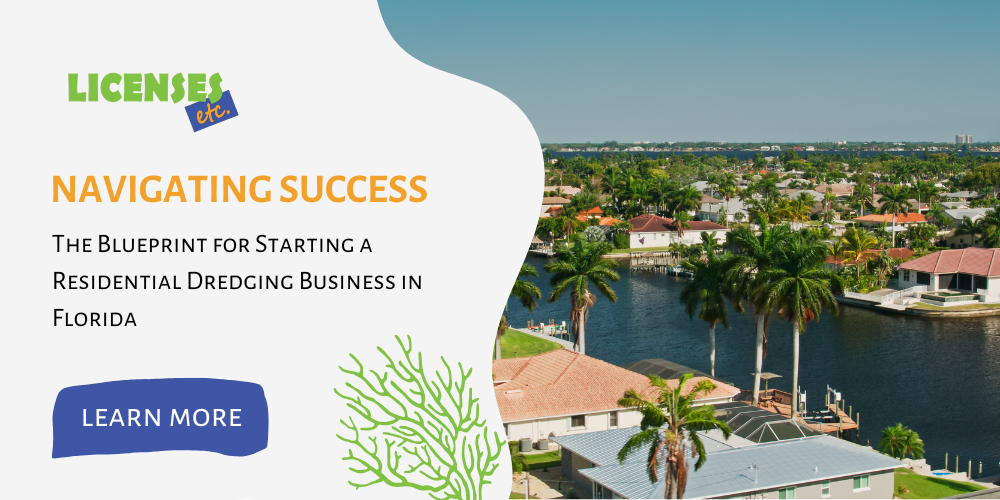
If you’ve ever looked at a Southwest Florida canal during low tide and seen boat lifts sitting in the mud, you’ve seen a massive business opportunity. In Florida, water depth isn’t just a luxury; it’s a property value essential.
For the ambitious contractor, residential maintenance dredging—restoring depth to boat lifts, docks, and private canals—is one of the most specialized and high-demand niches in the marine construction industry. But getting your barge in the water requires more than just a pump. Here is everything you need to know about breaking into this lucrative field.
What the Business Entails
Residential dredging is the process of removing accumulated sediment, silt, and debris from the bottom of a water body to restore “navigable depth.” Unlike massive harbor projects, residential work is a game of precision. You are working in tight spaces, often inches away from a client’s expensive boat lift or seawall.
Key services include:
-
Maintenance Dredging: Removing silt to keep canals clear.
-
Boat Lift Restoration: Ensuring deep-draft vessels can safely dock and depart.
-
Environmental Compliance: Managing the removal and legal disposal of “spoil” (the dredged material) according to Florida DEP standards.
Is it Profitable?
The short answer: Yes. Because dredging requires specialized equipment and significant regulatory knowledge, the “barrier to entry” is high, which keeps competition low and margins healthy.
-
Premium Pricing: Residential projects often range from $25 to $150 per cubic yard, depending on the material (sand vs. muck) and disposal logistics.
-
Recurring Revenue: Florida’s geography ensures that siltation is constant. A successful contractor doesn’t just dredge once; they provide maintenance plans for HOAs and luxury waterfront estates.
-
Asset Value: While the initial investment is high, the equipment (dredges and barges) tends to hold its value well in the Florida market.
Licensing: The “Certified Marine” Requirement
You cannot simply buy a pump and start charging neighbors. In Florida, dredging falls under the Certified Marine Contractor license category.
To get your license through the Department of Business and Professional Regulation (DBPR), you must:
-
Pass the State Exams: Both the Marine Trade Knowledge and the Business & Finance exams.
-
Prove Experience: You typically need four years of experience in the trade (with at least one year as a foreman) or a combination of education and experience.
-
Financial Stability: Demonstrate a minimum FICO credit score (usually 660+) or secure a bond.
Don’t forget the permits: Every job will require an Environmental Resource Permit (ERP) from the Florida Department of Environmental Protection (FDEP) and potentially the U.S. Army Corps of Engineers.
Specialized Insurance Needs
Standard General Liability (CGL) won’t cut it. Because you are working on the water, you need a “Marine Package” that typically includes:
-
Marine General Liability (MGL): To cover property damage to docks or seawalls.
-
USL&H (United States Longshore and Harbor Workers’ Compensation): A federal requirement for employees working over navigable waters.
-
Pollution Liability: Vital in case of a fuel spill or if dredging stirs up contaminated sediment.
-
Protection & Indemnity (P&I): Liability coverage specifically for your vessels and crew.
The Equipment Arsenal
To dominate the SWFL residential market, you need gear that is powerful yet “neighborhood friendly.”
-
Hydraulic Dredges (Cutter Suction): Use a rotating head to loosen silt and pump it through a pipe to a disposal site.
-
Mechanical Dredges (Long-Reach Excavators): Ideal for heavy debris and working from a barge.
-
Barges and Support Vessels: To transport equipment and material.
-
Dewatering Gear: Geotextile tubes or “bags” that separate the water from the muck so you can haul away dry soil.
How LicensesETC Can Help
Transitioning into dredging is a major move. You have enough to worry about with equipment leases and project bidding—let us handle the red tape.
At LicensesETC, we are experts in the Florida licensing process. If you are ready to expand your contracting horizons into the dredging world, we can:
-
Form Your Business Entity: Ensure your LLC or Corporation is structured correctly for marine work.
-
Manage Your License Application: We handle the “paperwork nightmare” of the DBPR to ensure your Marine Contractor application is approved the first time.
-
Verify Requirements: We’ll help you navigate the credit and background check requirements so there are no surprises.
Ready to clear the way for your new business? Contact us today and let’s get your Florida Marine Contractor license underway!