
- August 21, 2026
- Posted by: admin
- Category: Florida Contractor License Application
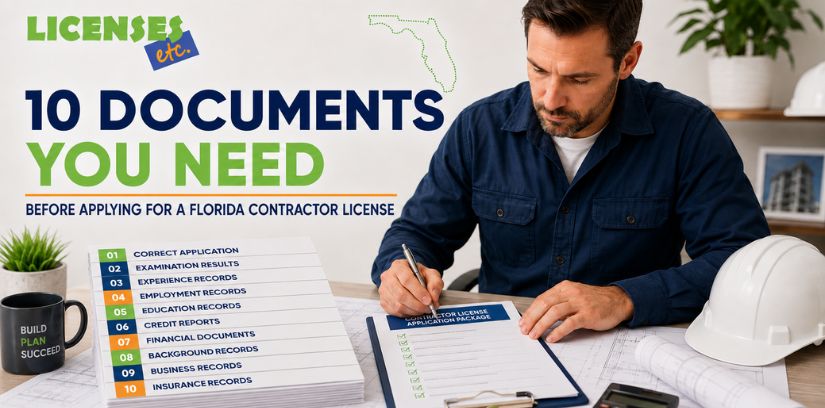
Applying for a Florida contractor license requires much more than passing an exam and completing a form. You must submit documentation that proves your identity, experience, financial responsibility, business status, insurance coverage, and eligibility for the license you are seeking.
The exact requirements depend on your license category, application type, business structure, experience, financial history, and personal background. Missing one document, using the wrong form, or submitting information that does not support your application can lead to a deficiency notice, additional expenses, or a significant delay.
That is why many applicants choose professional Florida contractor license application processing services instead of attempting to navigate the process alone.
LicensesETC helps contractors identify the correct application, build a customized document checklist, prepare the required forms, organize the supporting evidence, and submit a complete licensing package.
What Documents Do You Need for a Florida Contractor License?
Most applicants should be prepared to provide the following 10 categories of documents:
- The correct contractor license application
- Examination results
- Work experience verification
- Employment and income records
- Education or military records
- Personal and business credit reports
- Financial responsibility documents
- Fingerprinting and background documentation
- Business registration and ownership records
- Insurance and workers’ compensation documents
Not every applicant will need every document listed below. Some applicants may also need additional records based on their license type or personal circumstances. LicensesETC can determine what applies to your specific situation before your application reaches the state.
1. The Correct Florida Contractor License Application
The first document you need is the correct application from the Florida Department of Business and Professional Regulation, commonly called the DBPR.
This sounds simple, but Florida offers numerous contractor classifications and application types. The appropriate form may depend on:
- The contractor classification you are pursuing
- Whether you are applying by examination or endorsement
- Whether you are applying as an individual
- Whether you will qualify a business
- Whether you are changing your license status
- Whether you are qualifying an additional business
- Whether you are applying for a certified or registered license
Choosing the wrong form can waste time before the substantive review even begins.
LicensesETC evaluates your licensing goal and circumstances before preparing the application. This helps ensure you begin with the correct form, fees, supporting documents, and submission process.
2. Your Florida Contractor Examination Results
Applicants seeking many types of certified Florida contractor licenses must pass the required state examinations before applying for initial licensure.
You should retain documentation showing:
- The examinations you completed
- Your passing results
- The date each examination was passed
- The name used when registering for the exam
- Any candidate or identification numbers connected to your results
Your application information must match your testing records. Name differences, incomplete results, or expired eligibility periods can create complications.
Passing the exam is a major accomplishment, but it does not guarantee license approval. The application and supporting documentation must still demonstrate that you satisfy the remaining licensing requirements.
3. Detailed Work Experience Verification
Experience documentation is one of the most important and frequently misunderstood parts of a Florida contractor license application.
The Construction Industry Licensing Board does not simply need to know that you have worked in construction. Your documents must demonstrate that your experience is relevant to the license category you are requesting.
Depending on the license, the application may ask for information such as:
- Employer or company names
- Dates of employment
- Positions held
- Supervisory or foreman-level responsibilities
- Types of construction projects
- Project values
- Building sizes
- Number of stories
- Specific trade duties
- New construction experience
- Names and license information for contractors who can verify your work
General descriptions such as “performed construction work” or “managed projects” may not give reviewers enough information to evaluate your qualifications.
LicensesETC helps applicants present their experience clearly and in a format that addresses the requirements of the requested license. This is one of the most valuable reasons to have a licensing specialist prepare your application.
4. Employment and Income Records
Your work experience statements may need supporting documentation. Depending on your employment history and application type, that documentation could include:
- W-2 forms
- Pay stubs
- Tax records
- Employment verification records
- Corporate ownership documentation
- Contracts or project records
- Employer letters
- Licensed contractor attestations
- Building official verification
The state may evaluate whether your records support the dates, positions, and experience described in your application. Inconsistencies can raise questions and lead to requests for additional information.
For example, an applicant may have substantial hands-on experience but lack conventional employment records because the work was performed through self-employment, a family business, military service, or an out-of-state company. These circumstances require careful documentation.
LicensesETC reviews the complete history and helps determine which records can best support the applicant’s claimed experience.
5. Education or Military Service Records
Florida may allow certain education or military experience to satisfy part of an applicant’s experience requirements, depending on the license and circumstances.
Supporting records may include:
- College transcripts
- Degree certificates
- Construction-related education records
- Technical school transcripts
- Military discharge documents
- Military occupational records
- Service verification forms
- Training certificates
- Veteran fee-waiver documents
Do not assume that a degree, training program, or military occupation automatically substitutes for a specific amount of construction experience. The documentation must be relevant, complete, and presented under the applicable licensing rules.
LicensesETC can help evaluate how your education or military history may fit into the application and what additional field experience you may still need to document.
6. Personal and Business Credit Reports
Florida contractor license applicants generally must demonstrate financial stability and responsibility. This commonly requires a personal credit report and, when qualifying a business, a credit report for the business entity.
The reports must meet DBPR and Construction Industry Licensing Board requirements. A generic consumer credit report obtained from a bank, credit card company, or free credit-monitoring website may not contain everything the licensing board requires.
For example, the required report may need:
- A FICO-derived credit score
- Confirmation that local records were searched
- Confirmation that state records were searched
- Confirmation that federal records were searched
- The applicant’s correct legal identity
- The business entity’s correct legal name
LicensesETC offers DBPR-approved credit reports for Florida contractors, making it easier to obtain reports designed for the licensing process.
Ordering the wrong credit report can cost you time and force you to purchase another report. This is a small detail with the potential to create a large headache.
7. Financial Responsibility Documents
Your credit report may reveal issues that require additional documentation or corrective steps before the application is ready.
Depending on your circumstances, financial responsibility records could include:
- Proof that judgments have been satisfied
- Documentation addressing liens
- Records concerning delinquent accounts
- Bankruptcy documents
- Court records
- A licensing bond
- An irrevocable letter of credit
- Proof of completing an approved financial responsibility course
- Written explanations with supporting evidence
A lower credit score does not always mean that becoming licensed is impossible. It may mean that additional requirements must be satisfied.
The important question is not simply, “What is my credit score?” It is, “What does my financial record require me to do before submitting this particular application?”
LicensesETC can review the situation, explain the available path forward, and help prevent an avoidable financial issue from appearing without the necessary supporting documentation.
8. Fingerprinting and Background Documentation
Florida contractor license applicants must undergo a background check using the state’s required fingerprinting process.
Fingerprinting is generally completed through an approved Livescan provider. Applicants should retain any confirmation or transaction information associated with the submission.
If an applicant has a criminal history, disciplinary history, prior license issue, or an affirmative answer to a background question, additional documents may be required. These could include:
- Arrest records
- Certified court dispositions
- Sentencing records
- Probation or parole completion records
- Restoration-of-rights documents
- Written explanations
- Records involving prior professional licenses
- Administrative or disciplinary orders
A background issue should never be hidden or answered casually. An incomplete explanation or failure to disclose required information can become more serious than the underlying event.
LicensesETC helps applicants identify disclosure requirements and organize the documents needed to explain their circumstances accurately.
9. Business Registration and Ownership Records
If you plan to operate through a corporation, limited liability company, partnership, or other business entity, the business information must align with the contractor license application.
You may need records such as:
- Florida Division of Corporations registration
- Articles of incorporation or organization
- Foreign qualification documents
- Employer Identification Number confirmation
- Ownership records
- Corporate officer information
- Registered agent information
- Partnership agreements
- Fictitious name registration
- Organizational documents or meeting records
The business name on your application should match the official registration and related financial documents. Small differences involving punctuation, abbreviations, fictitious names, or entity designations can create inconsistencies.
If your company has not been established correctly, LicensesETC also provides Florida business formation services tailored to the construction industry.
Coordinating the business formation and contractor license application together can help prevent one process from creating problems for the other.
10. Liability Insurance and Workers’ Compensation Documents
Florida contractors must satisfy applicable public liability, property damage, and workers’ compensation requirements.
Depending on the application and timing, you may need:
- A certificate of liability insurance
- Proof of property damage coverage
- Workers’ compensation insurance documentation
- A workers’ compensation exemption
- Insurance information matching the correct applicant or business
- Attestations required by the licensing application
The name on the insurance documents must correspond to the person or business being licensed. Coverage documents issued under the wrong entity can cause confusion or require correction.
Some insurance and workers’ compensation requirements may become due at a particular stage of the licensing process. LicensesETC can help you understand what is needed, when it is needed, and which name should appear on the documentation.
Why Is a Florida Contractor License Application So Difficult?
The difficulty is not caused by one form. It comes from coordinating many requirements at the same time.
Your application, exam records, work history, credit reports, business documents, background information, and insurance records must tell a consistent story. A document may be valid by itself but still fail to support the specific statement or license requirement for which it was submitted.
Common problems include:
- Selecting the wrong application
- Omitting required sections
- Using vague experience descriptions
- Failing to document supervisory responsibilities
- Submitting an unacceptable credit report
- Using inconsistent personal or business names
- Missing required signatures
- Failing to disclose background information
- Providing business records that conflict with the application
- Sending documents in the wrong order or at the wrong time
Applicants often discover these problems only after the state issues a deficiency notice.
Can You Apply for a Florida Contractor License Without Professional Help?
Yes, applicants may prepare and submit their own applications. The more useful question is whether completing it alone is the best use of your time and whether you are confident that every part of the package supports your eligibility.
You already know your trade. You should not also have to become an expert in licensing forms, supporting evidence, credit-report standards, entity qualification, and DBPR procedures.
LicensesETC provides a structured application process that includes:
- Reviewing your licensing goals and qualifications
- Identifying the appropriate application
- Creating a customized document checklist
- Evaluating your work experience
- Organizing the required supporting records
- Preparing the state forms
- Reviewing the complete package for accuracy
- Submitting the application
- Monitoring its progress
- Helping address licensing-board inquiries
Learn more about how LicensesETC handles Florida contractor license applications.
Frequently Asked Questions About Florida Contractor License Documents
What is the most important document in a Florida contractor license application?
There is no single document that guarantees approval. However, work experience verification, qualifying financial reports, and the correct application form are among the most important components. These documents must work together to demonstrate eligibility.
Do I need both a personal and business credit report?
Applicants generally need a personal credit report. A business credit report may also be required when the applicant is qualifying a business entity. The correct reports depend on the application type and must meet the licensing board’s standards.
Can education replace construction experience?
Certain college education, training, or military service may satisfy part of the experience requirement. The amount of substitution and the necessary documentation depend on the applicant’s education, license category, and applicable rules.
What happens if my application is missing a document?
The state may issue a deficiency notice requesting additional information. This can delay the application and may require you to obtain, correct, or resubmit documents. A complete pre-submission review can help reduce preventable deficiencies.
Can I get a Florida contractor license with a low credit score?
A lower score may trigger additional financial responsibility requirements, such as a bond, letter of credit, or approved course. The appropriate response depends on the credit report and current licensing requirements.
Do I need to form my company before applying?
That depends on whether you are applying as an individual or qualifying a business. The sequence matters because the company name, ownership information, credit report, insurance, and application must be coordinated correctly.
How can LicensesETC help with my application?
LicensesETC can identify the appropriate licensing path, provide a personalized document checklist, prepare the application, review supporting evidence, assist with compliant credit reports, submit the package, and monitor the process.
Stop Guessing and Start Your Application the Right Way
A Florida contractor license can open the door to larger projects, new business opportunities, and the ability to work legally within the scope of your license. Getting there requires more than collecting a stack of documents.
You need the correct documents, completed correctly, submitted for the correct license, and supported by a consistent application.
Before spending hours sorting through forms or risking an avoidable deficiency, speak with specialists who handle Florida contractor licensing every day.
Call LicensesETC at 239-777-1028 or request a FREE telephone consultation. You can submit the online contact form or use the scheduling option to speak with a licensing expert.
Let LicensesETC handle the forms, documentation, submission, and follow-up so you can focus on building your contracting business.