
- July 22, 2026
- Posted by: admin
- Category: Florida Irrigation Contractor License
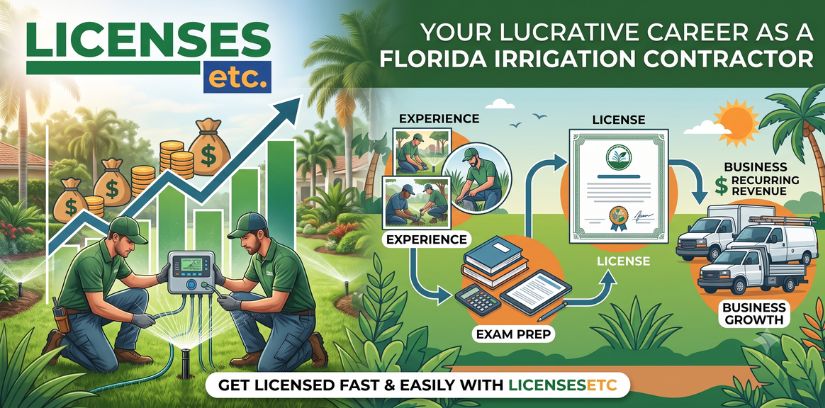
Florida is famous for its warm climate, sprawling golf courses, lush residential communities, and year-round agricultural productivity. Keeping Sunshine State landscapes thriving requires consistent, precise watering. That makes becoming a certified Florida Irrigation Specialty Contractor one of the most stable and financially rewarding paths in the skilled trades.
If you are evaluating new career opportunities or considering launching your own contracting company, irrigation is a high-demand specialty with significant revenue potential. Below is everything you need to know about what an irrigation contractor does, who they serve, how much money a business can generate, and how to navigate the licensing process successfully.
Key Takeaways
-
High Demand: Florida’s year-round growing season and rapid residential development create continuous demand for irrigation installation, smart upgrades, and routine maintenance.
-
Recurring Revenue: Income comes from initial high-ticket installations as well as steady recurring service contracts, backflow testing, and emergency repair work.
-
Licensing Requirements: Becoming a Certified Irrigation Specialty Contractor requires four years of proven experience (including one year as a foreman), passing required exams, and approval from the Florida Construction Industry Licensing Board (CILB).
-
Licensing Success: While 90% of self-submitted contractor license applications across Florida are rejected, working with LicensesETC yields a 99% approval rate on the first attempt.
What Is a Florida Irrigation Contractor?
A Florida Irrigation Specialty Contractor is a licensed professional qualified to install, maintain, repair, alter, extend, manage, monitor, audit, and design irrigation systems across residential, commercial, and agricultural properties.
An irrigation system encompasses all equipment installed for delivering and applying water to lawns and landscapes downstream of a water source or dedicated backflow preventer. This includes:
-
Water pumps and filtration systems
-
Main lines, lateral piping, and fittings
-
Solenoid valves and manifold assemblies
-
Irrigation controllers, control wiring, and smart timers
-
Rain shut-off devices and weather sensors
-
Sprinkler heads, rotors, and micro-irrigation components
-
Water conservation and water harvesting equipment
What Does the Job Entail?
Operating as an irrigation contractor involves a blend of technical installation skills, hydraulics knowledge, and modern water management. Daily responsibilities and projects typically include:
-
System Design and Engineering: Layout planning to optimize water coverage, pressure requirements, and zone distribution based on plant needs and soil conditions.
-
Excavation and Installation: Trenching, laying pipe, wiring controllers, and setting up valves, rotors, and drip lines.
-
Smart Technology Upgrades: Retrofitting older systems with smart WiFi-enabled controllers, rain shut-off sensors, and micro-irrigation to comply with Florida water conservation laws.
-
Maintenance and Repair: Diagnosing electrical shorts, fixing line breaks, replacing clogged nozzles, adjusting head alignment, and performing seasonal system checks.
-
Auditing and Water Efficiency: Performing audits to reduce water runoff, lower utility bills for clients, and meet municipal water usage standards.
Who Do Florida Irrigation Contractors Serve?
Because grass, trees, and landscaping need year-round watering across Florida, irrigation contractors serve a broad spectrum of property owners:
-
Residential Homeowners: Single-family homeowners looking for new installations, system repairs, or automated smart-watering upgrades.
-
HOAs and Residential Communities: Homeowners associations managing extensive common areas, entranceways, and neighborhood park spaces.
-
Commercial Properties: Retail centers, office complexes, industrial parks, and hotels requiring pristine curb appeal.
-
Golf Courses and Sports Facilities: Large turf management projects demanding complex, heavy-duty irrigation networks.
-
Agricultural Farms and Nurseries: Commercial growers relying on precise micro-irrigation and drip systems to protect crop yields.
How Do You Make Money, and How Lucrative Can the Business Be?
An irrigation contracting business in Florida can be extraordinarily lucrative because it combines high-margin upfront installation fees with predictable, recurring maintenance revenue. Because Florida’s climate demands constant water management, property owners cannot simply let their systems fail without risking thousands of dollars in lost turf, plants, and landscaping.
1. Expanded Revenue Streams & Pricing Breakdown
To build a high-ticket irrigation business, successful contractors diversify across multiple job types and pricing structures:
-
New Residential System Installations ($3,500 – $12,000+ per property):
-
Average single-family homes with 4 to 8 zones typically run between $3,500 and $6,500.
-
Custom high-end estates or multi-acre residential properties requiring deep well pumps, extensive zoning, and high-efficiency rotors can easily reach $12,000 to $25,000+.
-
-
Commercial & HOA Projects ($25,000 – $150,000+ per contract):
-
New construction subdivisions, shopping centers, office parks, and residential communities require large-scale piping, heavy-duty commercial pump stations, and sophisticated central satellite controllers.
-
-
Recurring Service & Monthly Maintenance Agreements ($75 – $500+ per month, per client):
-
Residential Checks: Offering quarterly or monthly tune-ups ($75–$150/visit) to check head alignment, clean filters, adjust seasonal timers, and inspect rain sensors.
-
HOA & Commercial Contracts: Monthly maintenance agreements for master communities range from $500 to $5,000+ per month depending on acreage, covering monthly wet checks, valve repairs, and zone monitoring.
-
-
Backflow Assembly Testing & Certification ($85 – $150 per test):
-
Florida municipalities require annual testing for backflow prevention devices connected to potable water lines. A licensed contractor can perform dozens of these quick, high-margin inspections in a single day.
-
-
High-Margin Repairs & Emergency Calls ($125 – $250/hr + Parts):
-
Common service work includes locating broken wire faults, replacing main valves ($200–$450), fixing mainline breaks ($250–$600), replacing burnt-out pumps ($800–$2,500), and converting old zone valves.
-
-
Smart Upgrades & Efficiency Retrofits ($500 – $2,500 per retrofit):
-
Upgrading older manual systems to WiFi-enabled smart controllers (like Rachio or Rain Bird LXME2), adding flow sensors, and converting overhead spray zones to low-volume drip irrigation. These upgrades save property owners up to 30%–50% on their water bills, making them an easy sales pitch.
-
2. Profit Margins & Cost Breakdown
The profit dynamics of an irrigation business are among the most favorable in the specialty construction trades. Overhead is relatively low compared to heavy general contracting because you do not need an expensive warehouse or massive equipment fleet to start.
-
Gross Profit Margins (40% to 60%): On raw installation work, materials (pipe, fittings, heads, wire, controllers) usually account for 20% to 30% of total job cost, while labor accounts for another 20% to 30%.
-
Net Profit Margins (20% to 35%): After accounting for vehicle fuel, insurance, licenses, marketing, and shop overhead, a well-managed irrigation company retains an exceptionally healthy net margin.
Example Financial Breakdown: Single Residential Install
Project Quote: $5,500 (6-Zone System)
Materials Cost: $1,200 (Pipes, fittings, valves, controller, heads, wire)
Labor Cost: $1,100 (2 Technicians for 1.5 days)
Equipment / Fuel / Overhead: $400
Net Profit on Job: $2,800 (50.9% Margin)
3. Realistic Annual Earnings Potential
What does this mean for your bottom line as a business owner? The earning potential scales smoothly from a solo truck operation up to a commercial fleet:
-
Solo Operator: Earning potential starts right away. By completing just two standard residential installs per week ($10,000) plus minor repair calls, a one-person setup with an assistant can generate over $250,000 annually.
-
Growing Fleet: As you stack monthly HOA maintenance contracts, those recurring retainers cover your fixed monthly expenses (truck payments, insurance, salaries). This leaves all new installation work as pure profit.
4. Why Florida Creates the Ultimate Business Environment
Unlike northern states where irrigation systems must be winterized and shut down for half the year, Florida irrigation businesses operate 365 days a year.
-
No Off-Season Downtime: Cash flow remains consistent throughout winter and spring.
-
Strict Water Laws: Florida’s strict water restriction laws enforce the use of working rain sensors and smart controllers, generating a constant stream of mandatory repair and compliance work.
-
Rapid Population & Housing Growth: Continuous residential expansion across Florida guarantees a steady supply of new property owners needing irrigation services.
How Do You Get Licensed as an Irrigation Contractor in Florida?
To operate legally as a Certified Irrigation Specialty Contractor in Florida, you must earn a license approved by the Florida Construction Industry Licensing Board (CILB).
Experience Requirements
You must demonstrate 4 years of hands-on experience, including a minimum of 1 year acting as a foreman. Up to 3 years of accredited college-level courses or active military service can be substituted for part of the experience requirement.
Your application must verify installation experience in both residential and commercial settings across all key categories:
-
Piping
-
Solenoid valves
-
Control wiring and irrigation controllers
-
Rain shut-off devices
-
Sprinkler sprays
-
Micro-irrigation components
If you lack experience in one specific category, your overall background may still be accepted, but it will require a specialized review by the Licensing Board.
How LicensesETC Helps You Get Licensed Fast
Navigating Florida contractor licensing can be complex and frustrating. In fact, nearly 90% of contractor license applications submitted independently are rejected or delayed due to paperwork errors, missing documentation, or incorrectly formatted experience histories.
When you work with LicensesETC, 99% of our applications sail through with no problems.
We do not just hand you forms to fill out. We analyze your complete work history and build a strategic, winning application designed specifically to meet CILB standards.
Why Choose LicensesETC?
-
Zero Stress: No confusing governmental forms or lengthy application packets for you to decipher.
-
Proven Track Record: Since 2007, we have helped tens of thousands of contractors successfully get licensed across Florida.
-
Fast Processing: We know exactly what the board looks for and handle the entire process from start to finish so you can keep working and earning money.
Ready to Start Your Florida Irrigation Contracting Business?
Do not let complicated state paperwork slow down your path to a lucrative business. Contact the licensing experts at LicensesETC today to get your Florida Irrigation Specialty Contractor license quickly and hassle-free.
-
Call Us Directly: (239) 777-1028
-
Online Contact: Visit our Contact Us Page
-
Schedule a Free Consultation: Book a call directly on our Calendly Consultation Page