
- August 14, 2026
- Posted by: admin
- Category: Florida Contractor Exam Application Services
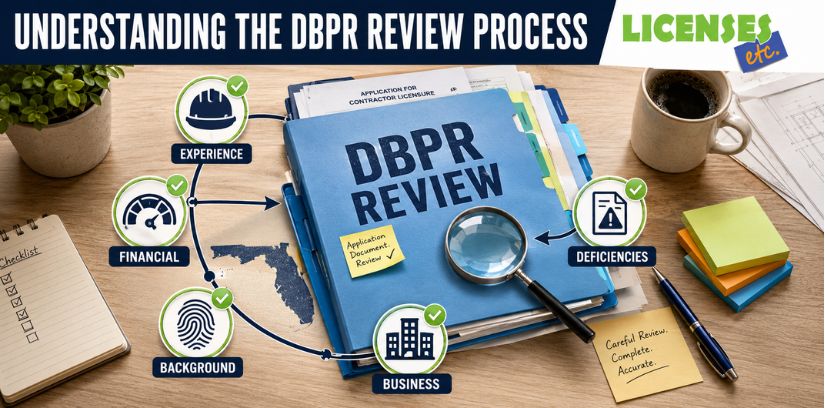
The Florida Department of Business and Professional Regulation does more than confirm that you submitted a contractor license application. DBPR reviews your application, supporting records, financial documentation, fingerprints, experience, business information, and other required materials to determine whether you satisfy Florida’s licensing requirements.
That review can become complicated quickly.
Submitting the wrong application, overlooking a required document, providing unclear work experience, or failing to coordinate related requirements can lead to a deficiency letter, additional review, or a delay in receiving a licensing decision.
For contractors who want to avoid preventable problems, understanding the DBPR review process is essential. It is also why many applicants choose professional Florida contractor license application processing services instead of trying to manage the process alone.
What Is the DBPR Review Process?
The DBPR review process is the state’s evaluation of your application and supporting documents to determine whether you qualify for the contractor license you requested.
For construction licenses, the process may involve DBPR staff and the Florida Construction Industry Licensing Board, commonly called the CILB. The exact requirements depend on factors such as:
- The contractor license classification
- Whether the license is certified or registered
- Whether you are applying by examination or endorsement
- Whether you will qualify a business
- Whether you are financially responsible for that business
- Your documented construction experience
- Your examination history
- Your personal and business credit information
- Your fingerprint and background-check results
- Any criminal, disciplinary, or licensing history
- Whether special circumstances require board review
The important distinction is that submitting an application does not necessarily mean DBPR considers it complete. A file may be received by the department but still lack information needed for substantive review.
What Happens After DBPR Receives an Application?
After DBPR receives your contractor license application, the file generally moves through several stages.
1. DBPR Identifies the Application and License Type
The department must first determine what you are applying for and whether the application matches the requested transaction.
This sounds simple, but Florida contractor licensing includes numerous license classifications and application types. An applicant may be seeking an individual license, qualifying a business, changing a license status, adding a business, applying by endorsement, or completing another transaction.
Choosing the wrong form or transaction can affect the entire submission.
A person may have sufficient trade experience and still encounter problems because the application was not structured for the license or business arrangement being requested.
2. The Application Is Checked for Apparent Errors and Omissions
Under Section 120.60 of the Florida Statutes, a licensing agency generally examines an application and has 30 days after receipt to notify the applicant of apparent errors or omissions and request permitted additional information.
This is an important part of the process, but it is often misunderstood.
The 30-day period does not necessarily mean your license will be approved within 30 days. It relates to the agency’s initial examination for apparent errors, omissions, and missing information.
If DBPR requests additional documentation, the application may not be considered complete until the requested items are received and the identified issues are corrected.
3. Supporting Documents Are Matched to the Application
A contractor license application is not reviewed in isolation. DBPR may need to match the application with several supporting items, including:
- Examination results
- Personal credit reports
- Business credit reports
- Fingerprint results
- Experience verification
- Business registration information
- Financially Responsible Officer documentation
- Surety bonds or letters of credit when applicable
- Insurance or workers’ compensation information
- Explanations and supporting records for background questions
- Fees, signatures, attestations, and required attachments
These materials may come from different sources and may not all arrive at the same time.
For example, DBPR states that fingerprints must be submitted through an FDLE-registered Livescan provider and notes that fingerprint results can take several days to reach the department. Credit reports must also meet specific requirements and cannot always be replaced by a general consumer report.
This creates a coordination problem. Even when an applicant believes everything has been completed, DBPR may be unable to finish its review if one component is missing, outdated, inconsistent, or not properly associated with the application.
What Does DBPR Review in a Contractor License Application?
DBPR is not simply checking whether every box contains an answer. Reviewers must determine whether the information proves that the applicant meets the applicable licensing requirements.
Does the Applicant Have the Required Experience?
Construction experience is one of the most important and potentially complicated parts of many contractor license applications.
An applicant must do more than list employers and job titles. The experience submitted must demonstrate work that is relevant to the scope of the requested license.
Potential problems include:
- Descriptions that are too broad or vague
- Experience that does not match the license classification
- Missing dates or inconsistent timelines
- Insufficient supervisory or management experience
- Project descriptions that do not establish the necessary scope of work
- Verification from someone who cannot adequately confirm the experience
- Gaps between the application and supporting records
A contractor may have years of real-world experience but still fail to communicate it in a way that allows a reviewer to confirm qualification.
LicensesETC helps applicants organize and present their experience clearly, accurately, and in relation to the license being requested. This is not about changing the facts. It is about making sure the facts are documented in a useful and reviewable format.
Has the Applicant Met the Financial Responsibility Requirements?
Financial documentation can create another layer of complexity.
According to the DBPR Construction Industry Licensing Board FAQs, contractor applicants generally must submit a credit report showing a FICO-derived credit score. If the applicant’s score is below 660, proof of completing a board-approved 14-hour financial responsibility and stability course may be required.
The application may also involve:
- A personal credit report
- A separate business credit report
- Public-record searches
- Documentation relating to liens or judgments
- A Financially Responsible Officer
- A surety bond or irrevocable letter of credit
- Additional financial explanations
The correct requirements depend on the applicant’s score, business structure, financial role, and license transaction.
Ordering the wrong report, omitting the business report, or assuming a standard credit-monitoring report will satisfy DBPR can delay the application. LicensesETC can help applicants identify and obtain the appropriate credit reports for Florida contractor licensing before the application reaches the review stage.
Do the Application, Business Records, and Supporting Documents Agree?
Consistency matters throughout the DBPR review process.
A reviewer may compare names, addresses, company information, ownership details, dates, employment records, and financial information across multiple documents. Even an innocent inconsistency can raise a question that requires clarification.
Examples include:
- A company name written differently on separate documents
- An application address that does not match business records
- Experience dates that overlap or conflict
- Missing middle names or suffixes
- An outdated corporate record
- A business entity that is not properly formed or active
- Different answers appearing in related application sections
- A requested license status that does not match the applicant’s business plan
These issues may seem minor to an applicant. To a licensing reviewer, they can prevent the file from establishing a clear and verifiable record.
Applicants who need to establish or organize a company should consider addressing Florida business formation requirements before submitting a contractor license application.
Are There Background Issues That Require Additional Documentation?
Fingerprinting and background questions are not procedural formalities. DBPR may evaluate criminal history, prior disciplinary action, license denials, or other matters disclosed by the applicant or identified during the review.
A background issue does not automatically mean an applicant cannot receive a license. However, incomplete disclosure or missing supporting documents can make the situation more difficult.
Depending on the circumstances, the applicant may need to provide:
- Court records
- Final dispositions
- Proof that conditions were completed
- Written explanations
- Rehabilitation evidence
- Records from another licensing authority
- Additional documents requested by DBPR or the board
The application questions must be read carefully. Assuming that an old matter, sealed record, dismissed case, or out-of-state issue does not need to be addressed can create a serious problem if the application requires disclosure.
What Is a DBPR Deficiency Letter?
A DBPR deficiency letter is a written notice identifying information, documents, corrections, or clarification that the department needs before it can continue processing an application.
Receiving a deficiency letter does not necessarily mean the application has been denied. It does mean the current submission has not provided everything needed for the review.
A deficiency letter may request:
- A corrected application page
- A missing signature or notarization
- Additional experience details
- A qualifying individual’s verification
- A compliant personal or business credit report
- Fingerprint completion
- Business registration documents
- A financial responsibility course certificate
- A bond or letter of credit
- Background documentation
- Clarification of inconsistent answers
- Additional fees or supporting forms
The response must address what DBPR actually requested. Sending an incomplete explanation, the wrong document, or an answer that creates new questions may prolong the process.
How Should You Respond to a DBPR Deficiency Letter?
The best response is complete, organized, accurate, and submitted within the applicable deadline.
Before responding, an applicant should determine:
- What DBPR is specifically requesting
- Why the original submission did not satisfy the requirement
- Which form, document, or explanation is needed
- Whether the response affects another part of the application
- Whether new signatures, verification, or third-party records are required
- How and where the response must be submitted
- What deadline applies
This can be harder than it appears. A short deficiency notice may refer to a statute, administrative rule, application instruction, or licensing requirement that the applicant does not immediately understand.
Responding quickly is useful only when the response is correct.
LicensesETC can help interpret the request, assemble the necessary documentation, and prepare a clear response that addresses the deficiency directly.
How Long Does the DBPR Review Process Take?
There is no single processing time that applies to every Florida contractor license application.
Florida law generally provides that a license application must be approved or denied within 90 days after the application is complete, unless another law establishes a shorter period. The critical phrase is “after the application is complete.”
The practical timeline can be affected by:
- Missing application information
- Delayed fingerprint results
- Noncompliant credit reports
- Questions about experience
- Background issues
- Requests for additional documentation
- The need for board review
- The timing of a board meeting
- How quickly the applicant answers a deficiency
- New discrepancies created by the response
This is why filing an application as quickly as possible is not always the fastest route to a license. A carefully prepared submission can be more valuable than a rushed submission that enters the system with unresolved issues.
Does Every Contractor Application Go Before the CILB?
Not every routine application necessarily requires the same level of board consideration. DBPR staff may be able to process applications that clearly satisfy the applicable requirements, while applications involving certain histories, unusual circumstances, disputed qualifications, or other issues may require additional review.
The Construction Industry Licensing Board meets regularly to consider licensing applications and other matters. If board review is required, the completeness of the application and the timing of the board’s meeting schedule can become especially important.
Missing a submission cutoff or arriving at board review with incomplete evidence can add substantial time to the process.
Can You Check the Status of a DBPR Application?
Yes. DBPR provides an online service that allows applicants to check the status of a license application.
However, a status label may not explain the full issue or tell you what should be done next. An application can appear to be processing while DBPR is matching supporting records, conducting a review, or waiting for another requirement to be satisfied.
Checking the portal repeatedly does not resolve an underlying documentation problem. Applicants must understand what the status means and whether any action is required.
Why Is Preparing the Application Correctly So Important?
DBPR reviews the record submitted to it. The reviewer does not know your work history, business structure, or licensing goals beyond what the application and supporting documents establish.
A strong application package helps the reviewer answer the necessary questions:
- Is this the correct application?
- Does the applicant meet the experience requirement?
- Is the experience relevant to the requested license?
- Have the financial requirements been satisfied?
- Are the fingerprints and background records available?
- Is the business properly structured?
- Do the supporting documents agree?
- Has every required question been answered?
- Is additional board review necessary?
When the package does not answer those questions clearly, the application can stall.
Why Hire LicensesETC for the DBPR Application Process?
Passing your contractor examinations and having years of construction experience do not automatically make the DBPR paperwork simple.
You may be highly qualified in the field and still lose valuable time trying to determine which form applies, how to document experience, what credit report is acceptable, how the business should be qualified, or how to answer a deficiency notice.
LicensesETC provides personalized contractor license application assistance from preparation through submission and follow-up. Services can include:
- Identifying the correct licensing application
- Providing a customized document checklist
- Reviewing experience and supporting records
- Preparing state application forms
- Coordinating required personal and business credit reports
- Checking the package for omissions and inconsistencies
- Organizing documents for submission
- Monitoring the application after filing
- Assisting with DBPR inquiries or deficiency letters
- Keeping the applicant informed throughout the process
The value is not simply having someone type information into a form. The value is having a licensing specialist understand how the separate requirements fit together before DBPR begins its review.
LicensesETC cannot remove the state’s requirements or guarantee how DBPR will decide an application. What the team can do is help you submit an accurate, organized, and well-supported application that avoids preventable mistakes.
Frequently Asked Questions About the DBPR Review Process
Does receiving a DBPR deficiency letter mean my application was denied?
No. A deficiency letter generally means DBPR needs additional information, documentation, or corrections before completing its review. The applicant must respond accurately and within the applicable deadline.
Can DBPR review an incomplete contractor license application?
DBPR may begin examining the submission, but the application may not be considered complete until requested information is provided and identified errors or omissions are corrected.
Is a submitted application the same as a complete application?
No. Submission means DBPR received the application. Completeness generally means the required information has been supplied and timely identified errors or omissions have been corrected.
What are common causes of DBPR application delays?
Common causes include missing signatures, incomplete experience verification, incorrect credit reports, delayed fingerprints, inconsistent business records, undisclosed background matters, missing supporting documents, and incomplete deficiency responses.
Can LicensesETC help after I receive a deficiency letter?
Yes. LicensesETC can review the deficiency, help determine what DBPR is requesting, and assist in preparing the necessary response and supporting documentation.
Is it better to hire LicensesETC before submitting an application?
Starting before submission gives LicensesETC an opportunity to identify potential issues before they enter the DBPR review process. However, assistance may also be available when an application has already been filed or a deficiency letter has been issued.
Do Not Let Paperwork Delay Your Florida Contractor License
The DBPR review process involves much more than completing a form. Your experience, examinations, financial records, fingerprints, business information, disclosures, and supporting documents must work together as one consistent application package.
A single unclear answer may lead to another question. One missing document may prevent the application from becoming complete. One incorrect assumption may cost weeks or require a complicated deficiency response.
You have already invested in your construction career. Do not let avoidable paperwork problems stand between you and your Florida contractor license.
Call LicensesETC at 239-777-1028 or request a free telephone consultation through the online form or Calendly. Let an experienced licensing specialist manage the details while you focus on building your business.