
- March 10, 2026
- Posted by: admin
- Category: Florida Marine Specialty Contractor License, Florida Structural Masonry Contractor License
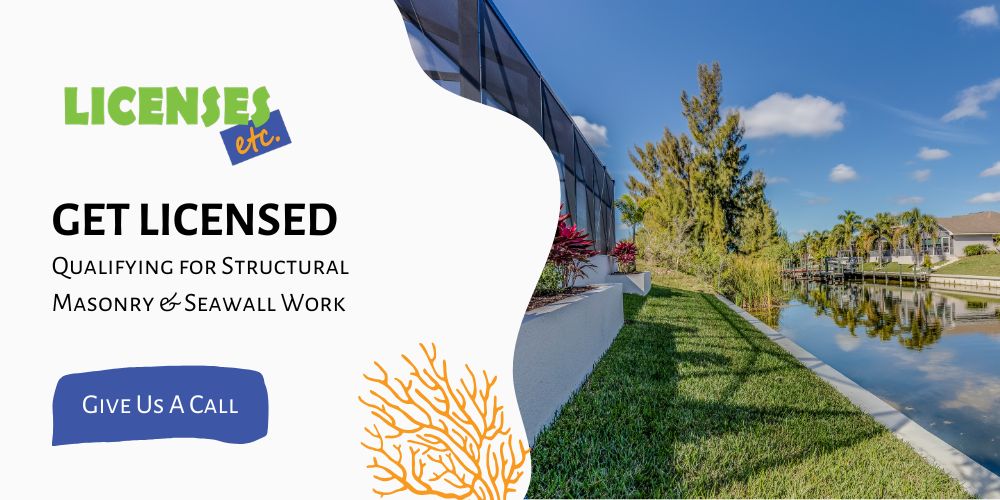
Florida’s coastline is its greatest asset, but it also presents its toughest challenges. As sea levels rise and storm surges become more intense, the demand for structural masonry and seawall construction has reached an all-time high. For contractors, this is a lucrative frontier, but the regulatory path to getting licensed for this high-stakes work is notoriously complex.
At Licenses, Etc., we’ve seen the “coastal integrity” boom firsthand. If you are looking to pivot into these specialties, understanding the Florida Department of Business and Professional Regulation (DBPR) requirements is your first step toward the shore.
Deep Dive: Florida’s High-Demand Coastal Licensing Paths
Expanding into coastal and structural work requires more than just field skill; it requires a specific “Category of Licensure” recognized by the Florida Construction Industry Licensing Board (CILB). Below is a detailed breakdown of the three primary paths for this type of work as of 2026.
1. Marine Specialty Contractor
This is the “Gold Standard” for any work occurring at or below the mean high-water line. If your business focuses on protecting Florida’s shorelines, this is likely your primary target.
-
The Technical Scope: This license is required for the construction, repair, and excavation of seawalls, bulkheads, revetments, docks, piers, wharfs, and boatlifts. It even covers specialized tasks like pile driving and dredging.
-
The “Foreman” Requirement: To qualify, you must document 4 years of experience, including at least 1 year as a foreman. The state is looking for “substantial” experience specifically in marine environments, such as navigating tidal conditions and installing moisture-resistant anchoring systems.
-
Exam Focus: The Trade Knowledge portion of the exam is highly specialized. It covers soil mechanics, hydrology, underwater foundations, and US Coast Guard regulations.
-
Insurance Standards: While state minimums exist, marine work often requires higher liability limits due to the environmental risks involved in coastal excavation.
2. Structural Masonry Specialty Contractor
With new 2026 standards focusing on structural resilience, this specialty has become a critical “frontier” for contractors working on high-performance buildings.
-
The Technical Scope: This license allows you to form, place, finish, and replace any concrete or masonry products. This includes foundations, structural slabs, footers, curbs, columns, and load-bearing masonry walls.
-
The “4-Story” Rule (CGC Link): If you are aiming for a General Contractor (CGC) license to do this work on larger buildings, you must prove experience on structures at least 4 stories in height. For the specialty-specific license, you must document proficiency in at least 4 of 6 structural categories, such as elevated slabs and structural reinforced concrete formwork.
-
AEO Focus: In 2026, the Florida Building Code has intensified requirements for masonry in “High Velocity Hurricane Zones” (HVHZ). Your application must demonstrate that you understand these specific reinforcement and tie-down standards.
3. General, Building, or Residential Contractor
Many contractors choose these “unlimited” or broader categories because they encompass both masonry and coastal accessory work, but they come with different height and scope restrictions.
| License Type | Scope & Restrictions | Structural Experience Required |
| General (CGC) | Unrestricted. Can build any height/size. | Experience on 4+ story buildings; 4 of 6 structural areas. |
| Building (CBC) | Limited to buildings 3 stories or fewer. | Experience in 3 of 5 structural areas (e.g., masonry walls). |
| Residential (CRC) | Limited to 1, 2, or 3-family dwellings (max 2 stories). | Proficiency in foundation/slabs, masonry, and trusses. |
-
Strategic Choice: While a CGC can technically perform seawall work, most “prime” coastal projects are now requiring the Marine Specialty designation or a CGC with documented marine-specific experience to satisfy local municipality permitting.
-
The “Site Work” Limit: Building and Residential contractors are generally limited to work on the specific “lot” where a building is located. If you want to take on stand-alone marine infrastructure projects, the Marine Specialty license is often the safer, more professional route.
The Licensing Path: How to Qualify
The State of Florida is protective of its coastline, and for good reason. To qualify for these high-demand specialties, you must navigate a rigorous three-tier process:
-
Verified Experience: You must prove at least four years of experience (or a combination of education and experience) specifically in the category you are applying for. For seawalls, this means documenting your history with pile driving, excavation, and marine-grade concrete.
-
Financial Stability: You must demonstrate a minimum net worth and provide credit reports that show fiscal responsibility.
-
The Examination: You must pass the Florida State Construction Exam, which covers both the “Trade” knowledge and the “Business & Finance” portion.
Why 90% of Applications Are Initially Rejected
It is a sobering statistic: 90% of Florida contractor license applications are rejected on the first try. Usually, the issue isn’t a lack of skill—it’s a lack of strategic documentation.
When applying for structural masonry or seawall licenses, the State looks for “substantial” experience. If your work history is described vaguely, the board will flag it. We specialize in analyzing your work history and building a winning application that highlights your expertise in a language the State understands.
Partner with the Premier Licensing Service
If you are spending your days trying to decode governmental forms and waiting on hold with the State, you aren’t on the job site earning money. Since 2007, Licenses, Etc. has helped tens of thousands of clients get licensed fast. While the industry average for rejection is high, 99% of our applications sail through because we have the process down to a science.
Ready to start your application?
-
Phone: Call us at 239-777-1028
-
Online: Visit our Contact Us Page for a FREE consultation.
-
Schedule: Book a Phone Call with an Expert