
- April 17, 2026
- Posted by: admin
- Category: Condo Repair Contractor License
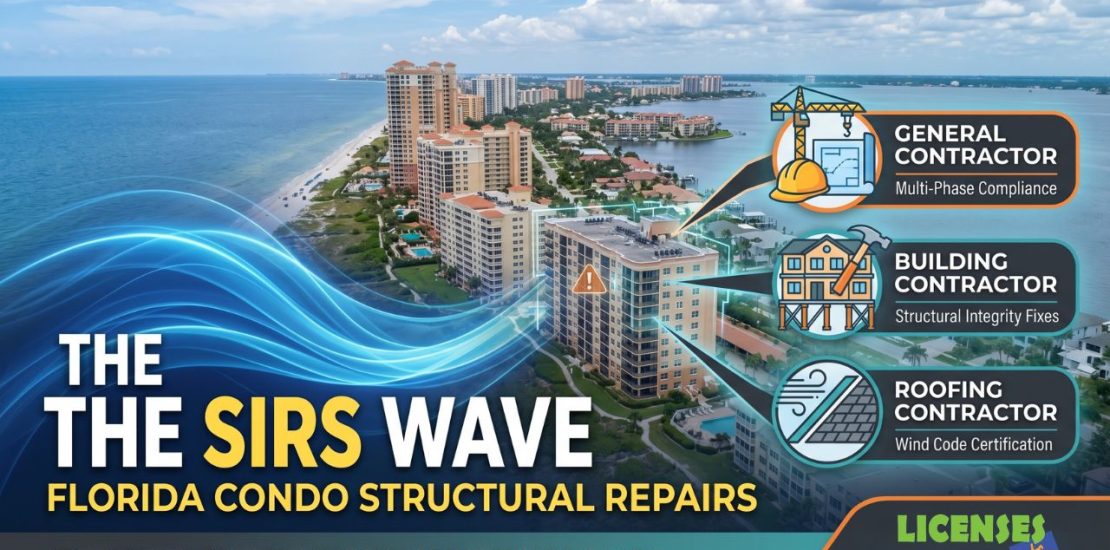
Florida’s real estate landscape is shifting. Following the tragic events of Champlain Towers South, the Florida Legislature passed Senate Bill 4-D and subsequent updates, mandating Structural Integrity Reserve Studies (SIRS). For homeowners’ associations (HOAs) and condo boards across Southwest Florida—from Naples to Tampa—the clock is ticking to complete necessary structural repairs.
For licensed contractors, this isn’t just a regulatory hurdle; it’s a massive market opportunity. But how do you position your license to win these high-stakes HOA contracts?
Understanding the SIRS Demand
A SIRS report specifically evaluates the visual inspection of primary structural members. If the report identifies deficiencies, the HOA is legally required to fund and execute repairs. The “SIRS Wave” refers to the thousands of condominiums now scrambling to find qualified, licensed professionals to perform this work.
The “Power Licenses” for Condo Repairs
While many specialty trades will be involved, three specific license types are best positioned to lead these projects. To win these high-stakes HOA contracts, you must demonstrate how your specific license class solves the technical and legal headaches of a Condo Board. They are:
1. General Contractor (GC): The Multi-Story & High-Rise Authority
In the world of Florida condominiums, the GC is the “Master of Compliance.” Because SIRS mandates focus heavily on buildings three stories and higher, the GC license is often the only one qualified to pull permits for major high-rise remediation.
-
The Scope:
-
Concrete Restoration & Rebar: SIRS reports frequently flag “spalling”—cracked concrete that exposes rusted rebar. GCs manage the heavy machinery and specialized crews needed for structural balcony repairs and foundation stabilization.
-
Post-Tension Cable Management: Many Florida condos utilize post-tension (PT) cables. GCs have the licensing breadth to oversee the delicate process of PT cable repair, critical for the building’s overall tension.
-
-
The Edge: HOAs prefer a single point of responsibility. You are the only license class authorized to manage the entire scope of a high-rise project, from structural concrete to final aesthetic finishes.
-
Marketing Angle: Position yourself as the “Compliance Partner.” Highlight your ability to manage the logistics, engineering coordination, and multi-phase scheduling required by the State.
2. Building Contractor: The Mid-Rise & Envelope Specialist
Building Contractors are perfectly positioned for the massive market of two- and three-story “garden-style” condos and townhome communities common across Southwest Florida.
-
The Scope:
-
Building Envelope Integrity: SIRS requires a visual inspection of “waterproofing and exterior painting.” Market your expertise in resealing the building envelope to prevent the moisture intrusion that leads to structural failures.
-
Structural Framing & Load-Bearing Walls: If the study finds wood rot or termite damage in headers or load-bearing assemblies, you are the primary choice for these localized but critical structural fixes.
-
-
The Edge: Many SIRS requirements focus on the building envelope and wood/masonry framing. In the 3-story-and-under market, you are often the most specialized and cost-effective choice.
-
Marketing Angle: Focus on “Structural Longevity.” Emphasize your deep knowledge of the specific height-class of the HOA to prove you are more efficient than a massive high-rise GC for their specific architecture.
3. Roofing Contractor: Protecting the “First Line of Defense”
The roof is one of the most expensive items in a SIRS reserve budget. Because a failure here leads to catastrophic damage to the rest of the structure, Roofing Contractors are the most vital “preventative” force.
-
The Scope:
-
Mandatory Life-Cycle Planning: SIRS requires HOAs to plan for the end of a roof’s life. Don’t just offer a patch; offer a 10-year compliance roadmap that aligns with their reserve funding requirements.
-
Parapet & Drainage Systems: SIRS looks at drainage. You are authorized to repair internal drains, scuppers, and parapet walls—elements that, if ignored, cause water to pool and lead to structural deck collapse.
-
-
The Edge: You are a “Primary Systems Expert.” The roof is a non-negotiable component of every single SIRS report.
-
Marketing Angle: Highlight “Liability Protection.” A new, compliant roof isn’t just about stopping leaks; it’s about protecting the building’s structural integrity and the board’s fiduciary duty. Frame your services as a way to secure lower insurance premiums and higher property values.
How to Market Your License to HOAs
To win these contracts, you need to speak the language of a Condo Board: Compliance, Budget, and Longevity.
-
Highlight Your Credentials: Don’t just say you’re licensed. Showcase that your license is in good standing and that you understand the specific SIRS milestones.
-
Lead with Education: Host a “SIRS Awareness” lunch-and-learn for property managers. When you explain the law, you become the expert they trust to fix the problem.
-
Focus on Southwest Florida: Whether you are in Cape Coral, Fort Myers, or Sarasota, emphasize your familiarity with local coastal building codes and salt-air mitigation.
Need to Upgrade or Secure Your License?
The SIRS wave is here, and the demand for licensed professionals is at an all-time high. If you are operating without the proper license or need to upgrade from a Residential to a Building or General license to take on these larger condo projects, don’t let the paperwork hold you back.
At Licenses, Etc., we know exactly what the board is looking for. We don’t just fill out forms; we strategically build your application to ensure it sails through the state’s rigorous review process.
Get licensed fast and catch the SIRS wave:
-
Call us: (239) 777-1028
-
Online: Request a FREE Consultation
-
Schedule: Book a Phone Call via Calendly